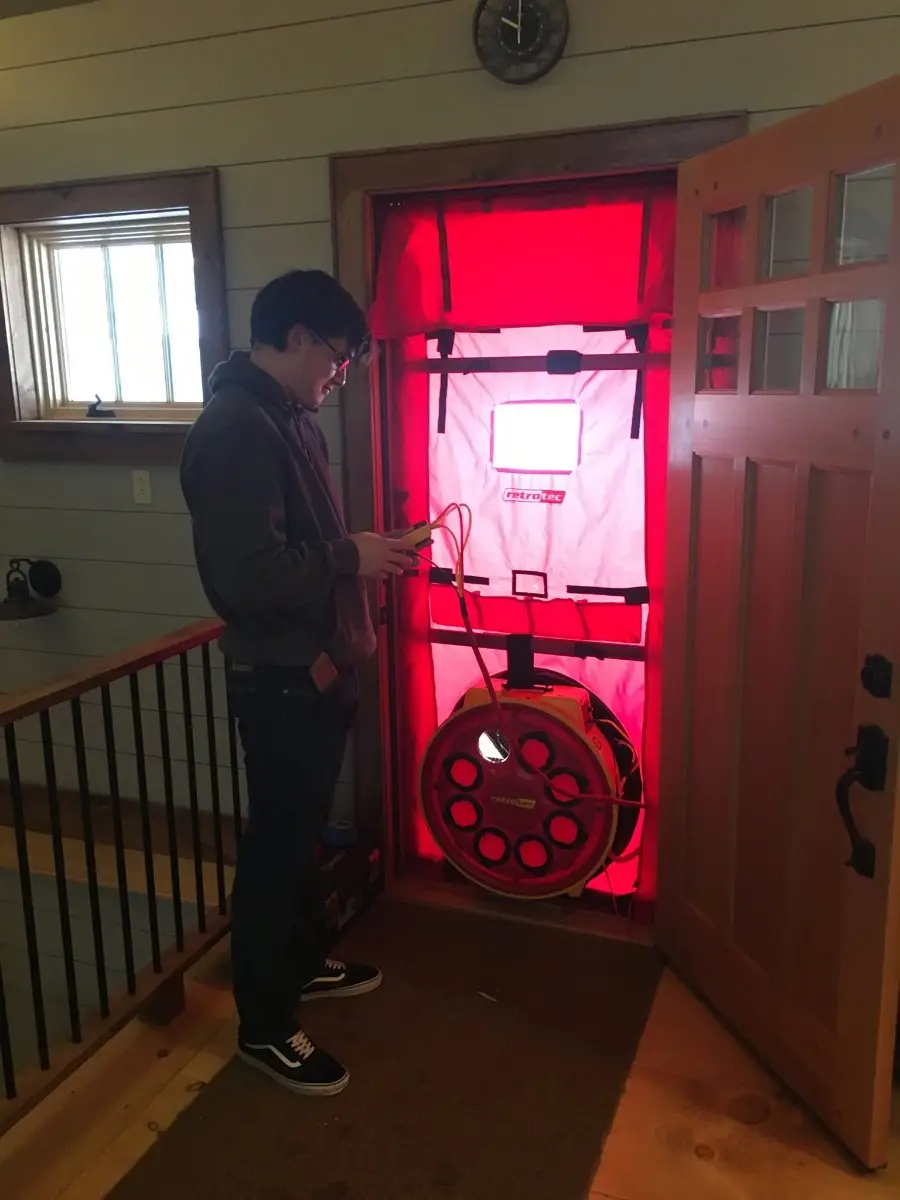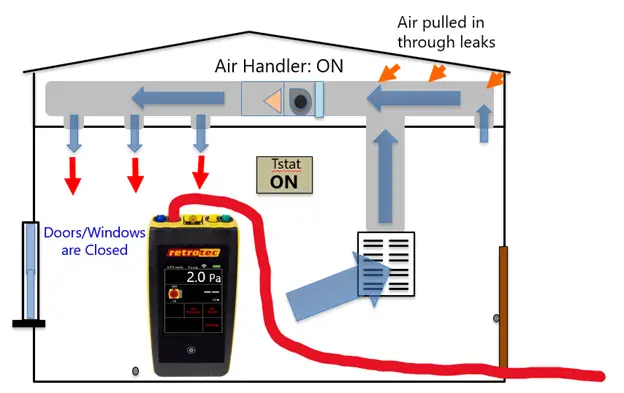
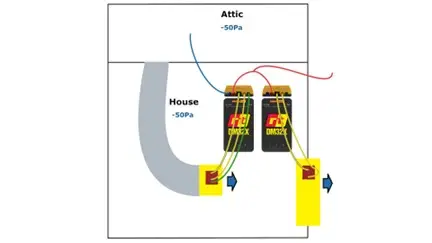

The blower door is installed and used to pressurize the house to +25 Pa relative to the external environment. This establishes a baseline pressure inside the building.
The Retrotec DucTester is connected to the return ducting via a sealed flange and flex duct. All other supply and return registers are sealed to prevent air movement elsewhere.
With the house held at +25 Pa, the duct tester is activated to depressurize the ducts to 0 Pa relative to the house interior. This creates a 25 Pa pressure differential between inside the ducts and the outdoors.
The gauge records the airflow required to maintain this pressure—providing a reading in CFM25, which reflects the volume of air leaking from the duct system directly to the outdoors through attic, crawlspace, or wall cavity leaks.
Energy efficiency: Identifies conditioned air lost outside the thermal envelope, leading to potential energy savings.
Standards compliance: Meets ENERGY STAR thresholds (max. 4 CFM25 per 100 ft² or ≤ 40 CFM25 total)
Health & comfort: Detects leaks that could draw dust or insulation particles into the HVAC air stream.
Perform a second reading: Measure both return and supply ducts, then average the two to account for system variances.
Seal thoroughly: Ensure registers, flanges, and tubing are airtight to avoid skewing results.
Test environments: Duct leakage tests are most critical when ducts are in unconditioned spaces—though hidden ducts in walls may leak outdoors as well.