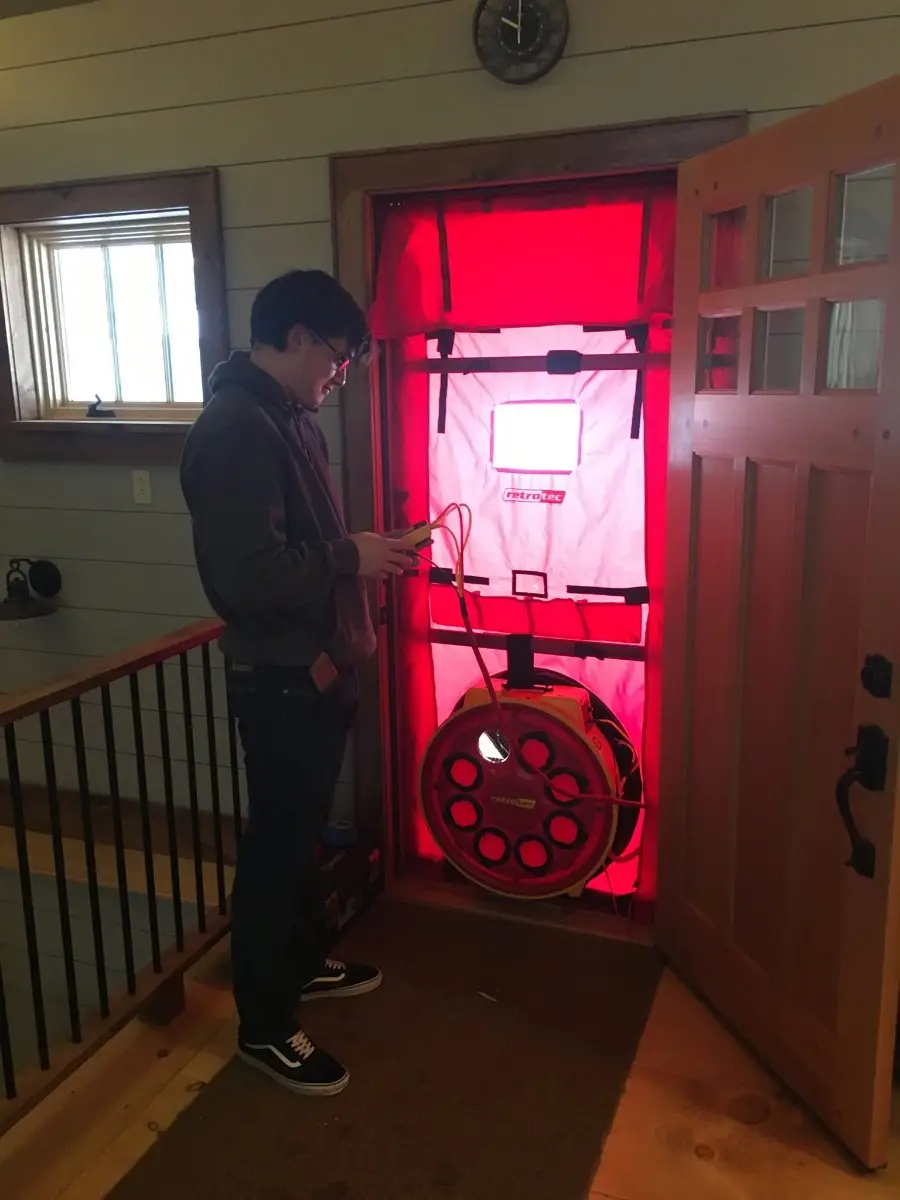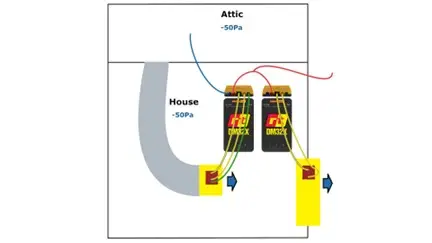

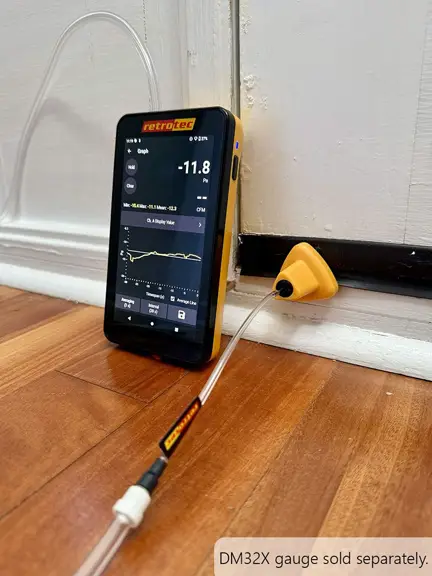
Unlike dual-gauge methods, this technique requires the tester to manually alternately measure house pressure and duct pressure with a single gauge:
Connect the duct tester (DucTester) to the duct system via flange and sealed flex duct.
Seal all other registers.
Run gauge tubes so Channel A can be switched between house and duct, using outdoor reference on Channel B.
Use the DucTester fan to raise duct pressure to +25 Pa.
Stabilize and record airflow.
With Channel A on duct, gauge shows duct pressure.
Disconnect Channel A from duct and reconnect to house interior.
Adjust blower door fan to raise the house interior to +25 Pa.
This equals house and duct pressure relative to outdoors.
Switch back Channel A to duct connection.
Fan speed adjustments are done until duct pressure returns to +25 Pa.
Once stable, the gauge shows flow in CFM@25 Pa, representing leakage to outdoors
Tube Switching Precision: Reconnecting Channel A must be done carefully to avoid airflow disturbance and ensure pressures match.
Pressure Stability Requirement: Both duct and house pressures must sit within ±1 Pa before readings are taken.
Timing Sensitivity: The process requires methodical sequencing—missteps impact result validity.
Use Stabilization Time: After each reconnection, allow around 60 seconds for pressure to settle.
Watch the “@” Indicator: Enables accurate readings at the setpoint (e.g., +25 Pa).
Confirm Range Compatibility: If flow reads “–”, you may need to adjust the DucTester range ring or increase fan speed.
Consider Dual-Gauge Support: Using two gauges (one on blower door, one on DucTester) eliminates tube re-plugging and simplifies steady pressure maintenance