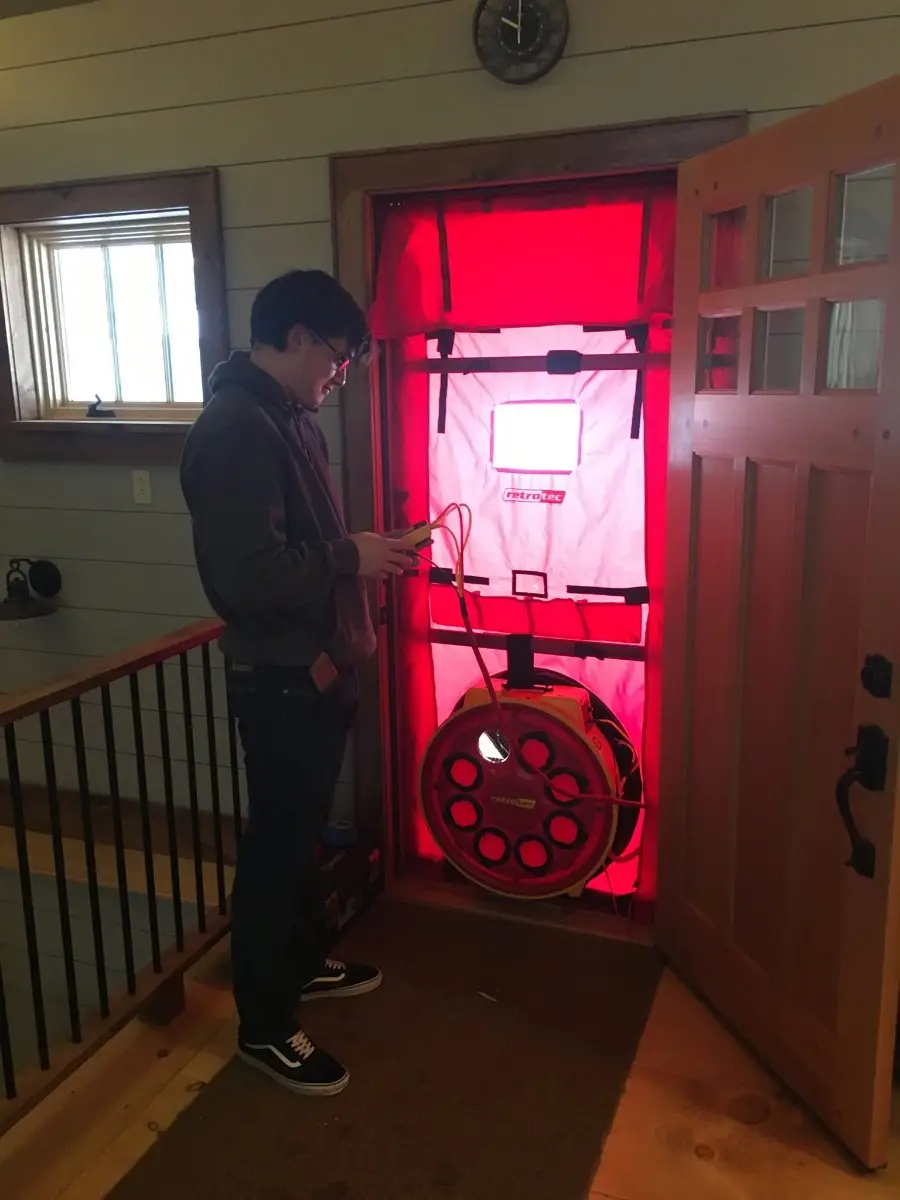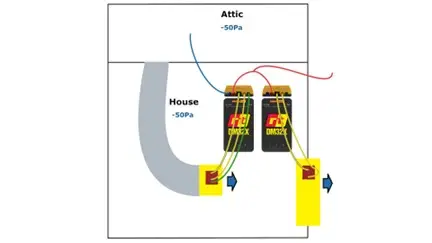

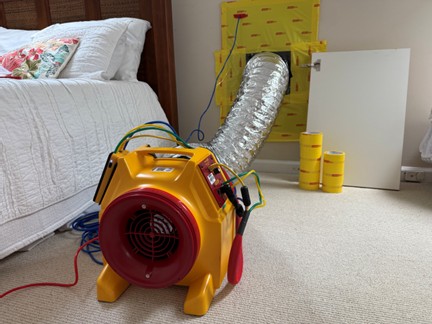
Under the 2009 IECC, builder compliance with blower-door testing is optional: either perform a test or confirm prescriptive sealing requirements. If chosen:
The leakage limit is ≤ 7 ACH50 for climate zones 1–8.
Tests must follow ASTM E779 or E1827 protocols.
2009 IECC sets thresholds depending on timing and system completion:
Post-construction test:
If air handler is installed: total leakage ≤ 12 CFM25 per 100 ft².
Or leakage-to-outdoors ≤ 8 CFM25 per 100 ft².
Rough-in test (before handler):
≤ 6 CFM25 with air handler installed.
≤ 4 CFM25 without air handler.
These limits were systematically tightened in later versions (e.g. 2012 or 2015).
Tests should be executed after all open penetrations are sealed, typically after drywall, flooring, and trim are in place:
For duct tests, seal all supply and return registers, leaving only the duct-testing fan port open.
Test conducted at 50 Pa for blower door and 25 Pa for duct leakage tests.
([turn0search33] turn0search17] for timing; [turn0search27] for pressures)
Testing methodology aligns with ASTM E1554, ANSI/RESNET/ICC 380, or similar protocols for duct test curves and fan-flow assessment.
After testing, a written report signed by the tester is typically required by local jurisdictions, documenting:
Final flow or ACH50 value.
Leakage per 100 ft² and pass/fail against code limits.
Test method, pressure, date, and climate zone.
Reports allow either Excel or PDF exports, depending on the auditor or AHJ requirements.
Yes — the 2009 IECC permits that option for envelope compliance as an alternative, but duct leakage always requires testing if ducts are outside the envelope.
By 2012 IECC, envelope testing becomes mandatory, and leakage thresholds decline sharply: ≤ 3 ACH50 in climate zones 3–8, and ≤ 5 ACH50 in zones 1–2.
Under 2009 IECC, duct testing isn’t required if both ducts and air handler remain inside the thermal boundary.