Introduction
In our latest podcast episode, we had the pleasure of hosting Niek-Jan Bink from ACIN, where Sam and I dove into the fascinating story behind the FlowFinder and ACIN’s journey in building science and technology. This conversation offered a behind-the-scenes look at the FlowFinder’s origin story, its evolution, and the pioneering work being done on new tools like the UltraGraphx and the ATT Tester. Here’s a recap of our conversation with Niek-Jan, which offers insights into the past, present, and future of air quality and building science solutions.
A Deep Dive into the FlowFinder’s Origins
The FlowFinder is perhaps our industry’s most well-known ACIN product, yet its story is filled with unique challenges and innovative engineering solutions. Niek-Jan shared how his journey began as a climate researcher, later joining ACIN and ultimately driving significant advancements in the field. The FlowFinder itself originated from a unique blend of academic insights and industry needs: in the early days, ventilation systems were installed with little understanding of airflow balance, often leading to health issues due to poor air quality.
Over time, the FlowFinder evolved from a simple, manually controlled device to today’s sophisticated digital version. The latest iteration, the FlowFinder Mark II Plus, features a display, Wi-Fi capabilities, and soon, compatibility with a mobile app. These advancements allow professionals to monitor, control, and optimize airflow in buildings with remarkable precision.
Innovation in Real-Time Air Quality with the UltraGraphx
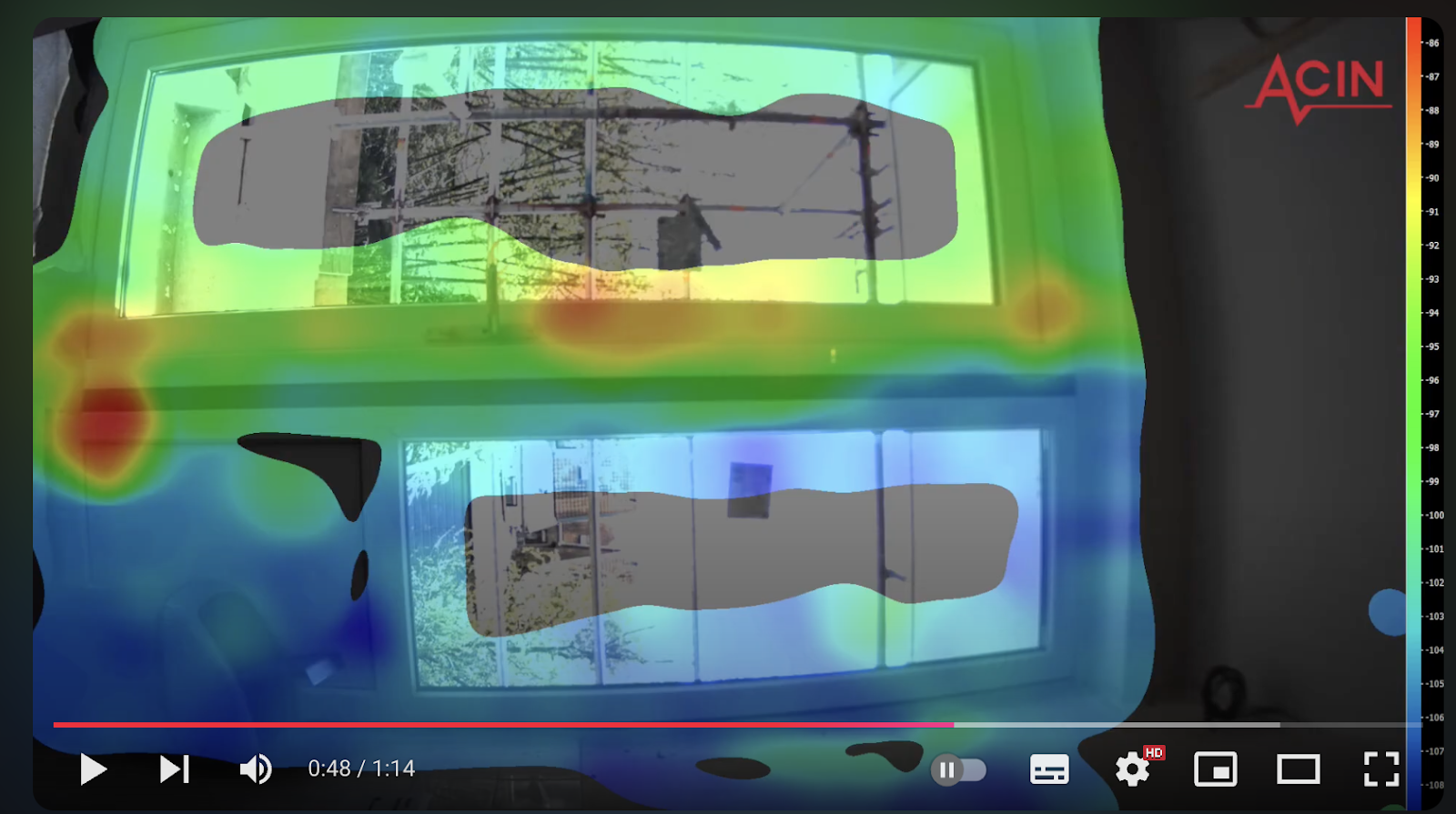
Niek-Jan discussed the UltraGraphx, a groundbreaking device that ACIN is bringing to the market to enhance the construction industry’s ability to detect and measure air leakages. The UltraGraphx uses ultrasonic technology to visualize leakages in real-time, even as buildings are under construction. This means professionals can inspect specific assemblies—such as window or door details—without needing to pressurize an entire building, providing a practical and powerful tool in detecting and resolving air leakage problems.
As Niek-Jan explained, the UltraGraphx is anticipated to be ready by late spring or early summer next year, and we’re excited to see how this technology will impact both residential and commercial construction.
Introducing the ATT Tester for Efficient Building Air Tightness Testing
Another exciting topic was the ATT Tester, which offers a novel approach to air tightness testing by measuring pressure differentials inside the building envelope. Unlike traditional blower doors that measure differential pressure against outside air, the ATT Tester holds a reference pressure within a closed vessel. This enables more flexible testing for individual apartments or rooms, especially in large buildings where traditional blower door setups are impractical or time-consuming.
According to Niek-Jan, this technology is well-suited for environments where multiple units need testing without disrupting the building’s internal pressure balance. With minimal setup, the ATT Tester could simplify air tightness testing, particularly in regions like Europe, where a sample-based approach to compliance is common.
Expanding Applications of the FlowFinder in the US Market
In the U.S., the FlowFinder is increasingly utilized beyond traditional HVAC balancing. Professionals are discovering its versatility in measuring airflow in whole-house ventilation systems, bathroom and kitchen exhausts, and even in individual components, such as recessed lighting. With its active flow hood technology and calibrated fan, the FlowFinder delivers precise measurements essential for achieving optimal air quality standards in today’s tightly built homes.
Niek-Jan noted that European applications of the FlowFinder tend to be more focused on commissioning, but in the U.S., its uses have broadened significantly. This reflects the diverse air quality challenges and building practices across regions and the adaptability of the FlowFinder to meet those needs.
Staying Curious and Committed to Building Science Innovation
A memorable moment from our conversation was Niek-Jan’s advice to “stay curious.” He emphasized that in building science, much of the advancement comes from listening to others, observing challenges, and seeking innovative solutions. His insights remind us that the tools we create are only as good as the understanding and curiosity we apply to their development.
Wrapping Up
We’re grateful to Niek-Jan for sharing his stories and expertise, from the FlowFinder’s humble beginnings to the groundbreaking tools ACIN is developing today. This conversation sheds light on how far building science technology has come—and where it’s heading. We look forward to seeing the impact of tools like the UltraGraphx and the ATT Tester in the field and are excited to keep sharing these advancements with you on our podcast.
Stay tuned for more episodes, and as always, stay curious.