What Are Range Rings & Plates?
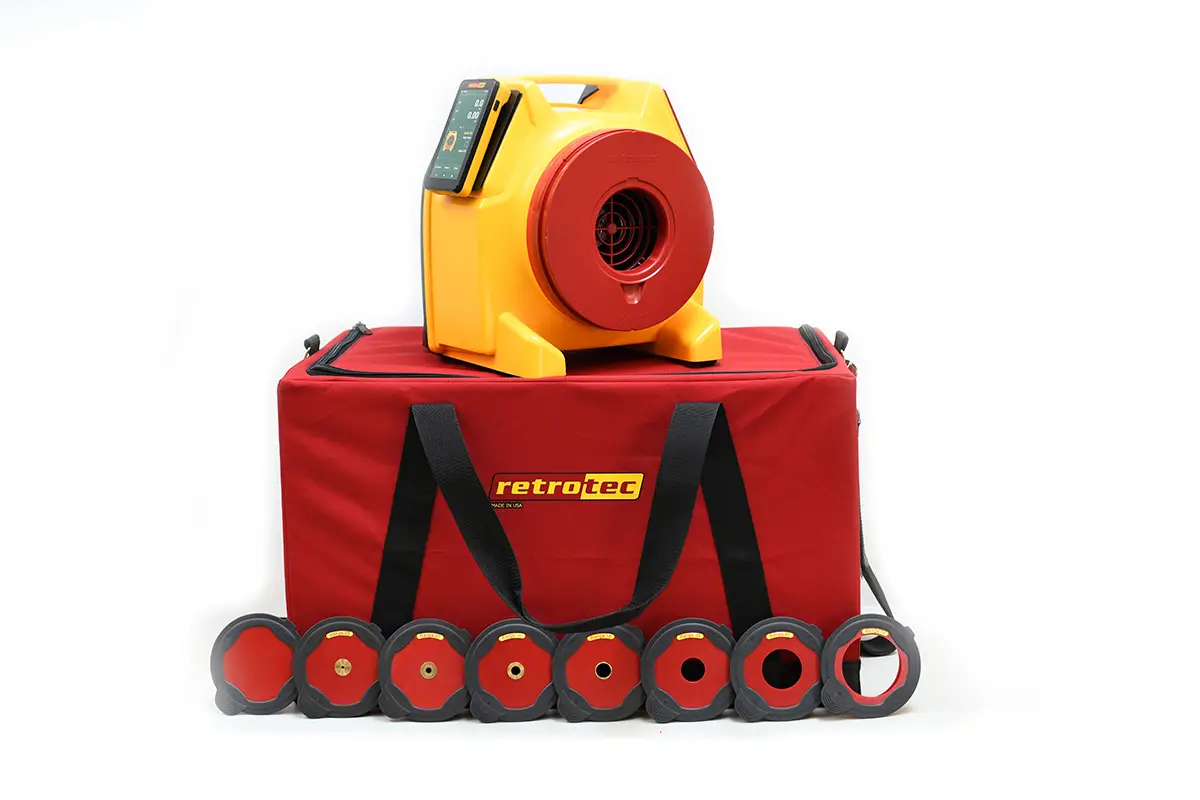
Range rings (or plates) are restrictive attachments placed on the blower-door fan inlet. They narrow the airflow, increasing fan pressure, which improves measurement precision—especially at lower flow rates where the gauge needs sufficient pressure differential to provide reliable data.
Why Range Selection Matters
Measurement Resolution
- Too little restriction yields low fan pressure, which may fall below the gauge’s readable range.
Fan Efficiency & Cooling
- Higher fan pressure enables faster fan speeds, helping prevent the motor from overheating.
Test Accuracy Across Multiple Points
- Using a restrictive configuration throughout the test avoids mid-course adjustments, ensuring continuity and consistency
How to Select the Correct Range
Here’s Retrotec’s recommended process:
Install the most restrictive range you anticipate needing (e.g., small-hole ring).
Secure the range ring, making sure alignment pins are properly seated.
Adjust fan speed until you reach your target test pressure (e.g., 50 Pa).
If the gauge displays “– –”, flow is too low—add more restriction by switching to a smaller-hole ring or plate and retest.
Monitor fan pressure on the gauge (PrB). The ideal fan pressure is at least twice your test pressure (e.g., ≥ 100 Pa for a 50 Pa test).
Proceed with the blower‑door test on that range ring for both single- and multiple-point tests.
Quick Reference Table
| Test Pressure Target | Min. Fan Pressure Needed | Choose Range |
|---|---|---|
| 50 Pa | ≥ 100 Pa | Restrictive ring/plate |
| 75 Pa | ≥ 150 Pa | Smaller-hole ring if needed |
| Multi-point Tests | Maintain ≥2× at all points | Full-range coverage |
Bottom Line
Using the right range ring ensures:
Reliable readings by keeping fan pressure within gauge specs
Operational safety and fan cooling efficiency
Data consistency—no need to switch ranges mid-test